


A Complete Legal Guide for Property Buyers
Introduction
Buying land or property is one of the most significant financial decisions you’ll ever make. Whether you’re purchasing your first residential plot, investing in commercial real estate, or acquiring land for future development, the security of your investment largely depends on one thing: proper legal documentation.
Every year, thousands of Nigerians lose substantial sums of money because they purchase property without fully understanding the title documents involved. Some assume that physical possession automatically means legal ownership, while others believe that a simple receipt from the seller is sufficient proof of title. Unfortunately, these misconceptions often lead to disputes, financial loss, and, in some cases, the complete loss of the property.
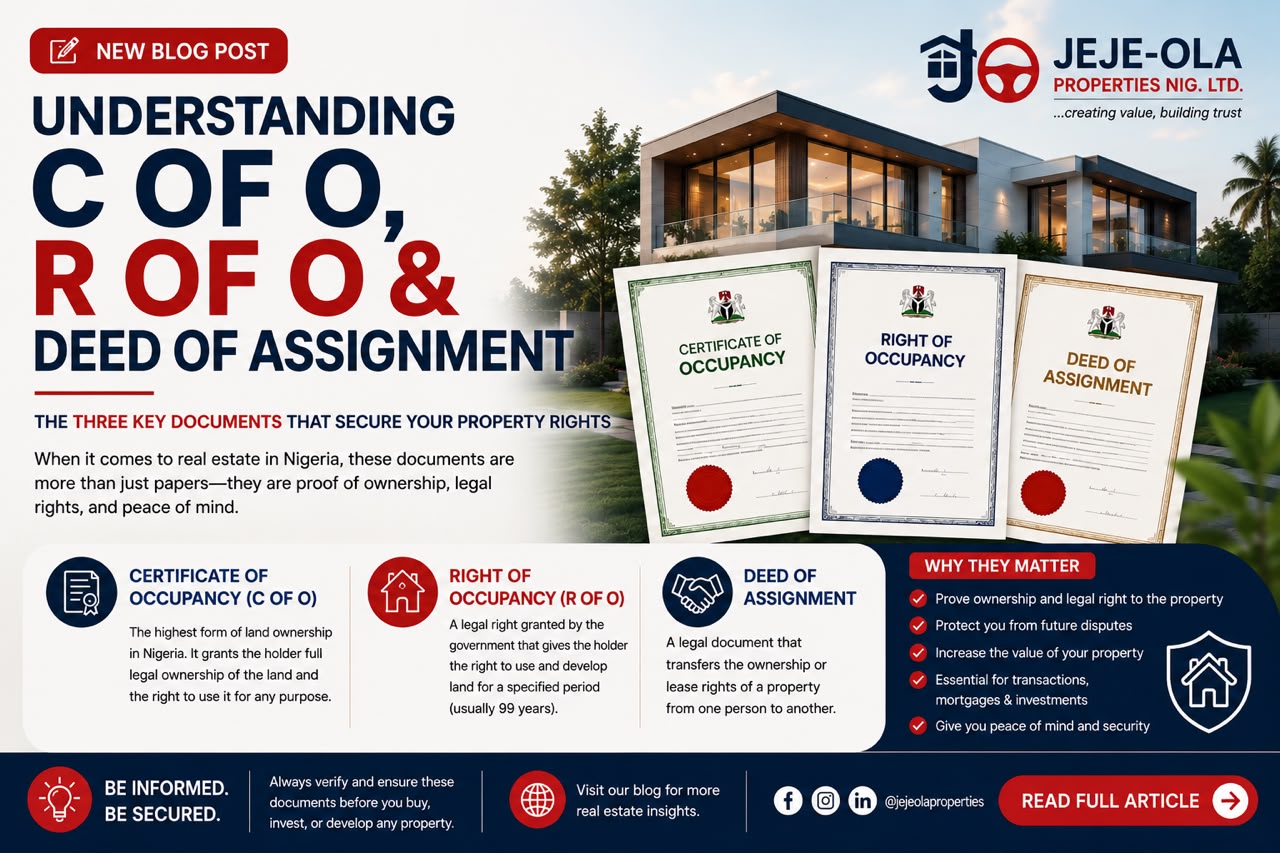
Among the most important property documents every buyer should understand are the Certificate of Occupancy (C of O), Right of Occupancy (R of O), and Deed of Assignment. Although these documents serve different legal purposes, they work together to establish, transfer, and protect interests in land.
This guide explains what each document is, how they differ, why they matter, and what every prospective property buyer in Nigeria should know before making a purchase.
Understanding Land Ownership Under the Nigerian Land Use Act
To understand the importance of these documents, it’s helpful to first understand how land ownership works in Nigeria.
The Land Use Act of 1978 transformed Nigeria’s land tenure system by vesting all land within each state (except land vested in the Federal Government) in the Governor of that state, who holds it in trust for the benefit of the people. This means that, rather than enjoying absolute freehold ownership, individuals and corporate bodies are granted legally recognised rights to occupy and use land for a specified period, subject to the provisions of the Act and other applicable laws.
As a result, a person’s interest in land is typically established through legally recognised title documents rather than by physical possession alone.
This is why documents such as the Certificate of Occupancy (C of O), Right of Occupancy (R of O), and Deed of Assignment are essential in any property transaction.
What is a Right of Occupancy (R of O)?
A Right of Occupancy (R of O) is the legal right granted under the Land Use Act that allows an individual or corporate body to occupy and use a specific parcel of land.
It is important to understand that the Right of Occupancy is the legal interest itself, as well as the document evidencing that right. Simply put, it gives the holder the legal authority to occupy, develop, and use the land for approved purposes, subject to the conditions of the grant and applicable laws. In most cases, a Right of Occupancy is granted for a term of 99 years, although the duration may vary depending on the applicable law and the specific circumstances.
Types of Right of Occupancy
1. Statutory Right of Occupancy
A Statutory Right of Occupancy is granted by the Governor of a State and generally applies to land in urban areas. It is the most common form of occupancy right for residential estates, commercial developments, industrial sites, and government land allocations.
2. Customary Right of Occupancy
A Customary Right of Occupancy is typically granted by a Local Government Authority over land in rural areas where customary land tenure applies. Although legally recognised, buyers should still carry out thorough due diligence before purchasing land held under customary arrangements.
Rights Enjoyed Under a Right of Occupancy
A holder of a Right of Occupancy generally has the right to:
- Occupy the land.
- Develop the land by constructing approved buildings or structures.
- Lease the property.
- Sell or transfer their interest in the property, subject to applicable legal requirements.
- Mortgage the property.
- Use the land only for the purpose for which it was granted.
These rights are subject to compliance with planning regulations, payment of statutory fees, and other legal obligations imposed by law.
What is a Certificate of Occupancy (C of O)?
A Certificate of Occupancy (C of O) is an official document issued by a State Government certifying that an individual or corporate body has been granted a Statutory Right of Occupancy over a specific parcel of land. It is one of the most important and widely recognised title documents in Nigeria because it confirms that the Government has formally recognised and documented the holder’s legal interest in the land.
A Certificate of Occupancy also contains key information about the property, including the holder’s details, the location and size of the land, its approved use, and other identifying particulars.
As explained earlier, it is important to note that possessing a Certificate of Occupancy does not mean the holder owns the land absolutely or indefinitely. Rather, it confirms the holder’s legally recognised interest in the land, subject to the provisions of the Land Use Act and the conditions under which it was granted.
Why is a Certificate of Occupancy Important?
A valid Certificate of Occupancy offers several important benefits:
1. It Confirms Government Recognition
It confirms that the State Government has formally recognised and documented the holder’s legal interest in the land.
2. It Helps Reduce Ownership Disputes
Because the land has been officially documented, it becomes much more difficult for multiple parties to assert competing claims over the same property.
3. It Can Increase Property Value
Properties with valid Certificates of Occupancy are generally more attractive to buyers and investors and often command higher market values.
4. It Facilitates Access to Finance
Banks and other financial institutions often require a valid title document before accepting property as security for a loan or other credit facility.
5. It Simplifies Future Transactions
Whether selling, leasing, or transferring an interest in the property, proper documentation makes the transaction smoother, more secure, and more efficient.
What is a Deed of Assignment?
While a Certificate of Occupancy confirms the Government’s grant of a legal interest in land, a Deed of Assignment is the legal instrument used to transfer that interest from one private party to another.
Whenever land or property is sold, the transaction should be documented through a properly prepared and executed Deed of Assignment. Without this document, it may be difficult for a buyer to establish that the seller’s interest has been validly transferred.
The parties to a Deed of Assignment are:
- Assignor – the person transferring their interest in the property (the seller).
- Assignee – the person acquiring that interest (the buyer).
A professionally prepared Deed of Assignment also contains important details such as the identities of the parties, a description of the property, the title being transferred, the agreed consideration (where applicable), and the terms and conditions governing the transfer.
Why is a Deed of Assignment Important?
A Deed of Assignment serves several important purposes:
It Provides Evidence of the Transfer
It serves as legal evidence that the seller’s interest in the property has been transferred to the buyer.
It Protects the Purchaser
A properly executed Deed of Assignment helps protect the buyer if the transaction or ownership of the property is later disputed.
It Establishes the Chain of Title
Every property should have a traceable ownership history. A Deed of Assignment forms an important link in that chain, making it easier to verify previous transactions involving the property.
It Facilitates Registration
The Deed may be registered at the appropriate Lands Registry, strengthening the buyer’s legal position and creating a public record of the transfer.
Certificate of Occupancy vs Right of Occupancy vs Deed of Assignment
Although these terms are often used interchangeably, they perform distinct legal functions.
| Document | Meaning | Purpose |
| Right of Occupancy (R of O) | The legal right granted under the Land Use Act to occupy and use land. | Establishes the holder’s legal interest in the land. |
| Certificate of Occupancy (C of O) | The official document issued by the Government certifying the grant of a Statutory Right of Occupancy. | Confirms and records the Government’s grant of that right. |
| Deed of Assignment | The legal instrument used to transfer an interest in land between private parties. | Transfers the seller’s interest in the property to the buyer. |
Conclusion
Real estate remains one of the most rewarding investments in Nigeria, but only when every transaction is backed by proper legal documentation and thorough due diligence.
Understanding the distinct roles of the Right of Occupancy (R of O), Certificate of Occupancy (C of O), and Deed of Assignment will help you make informed decisions and avoid costly mistakes when buying property.
At JEJE-OLA PROPERTIES NIG. LTD., we are committed to helping individuals, families, and investors purchase property with confidence. Through verified title documents, transparent transactions, and professional guidance, we help ensure that every investment is built on a solid legal foundation.
Whether you’re buying your first plot of land or expanding your property portfolio, our experienced team is ready to guide you every step of the way.