


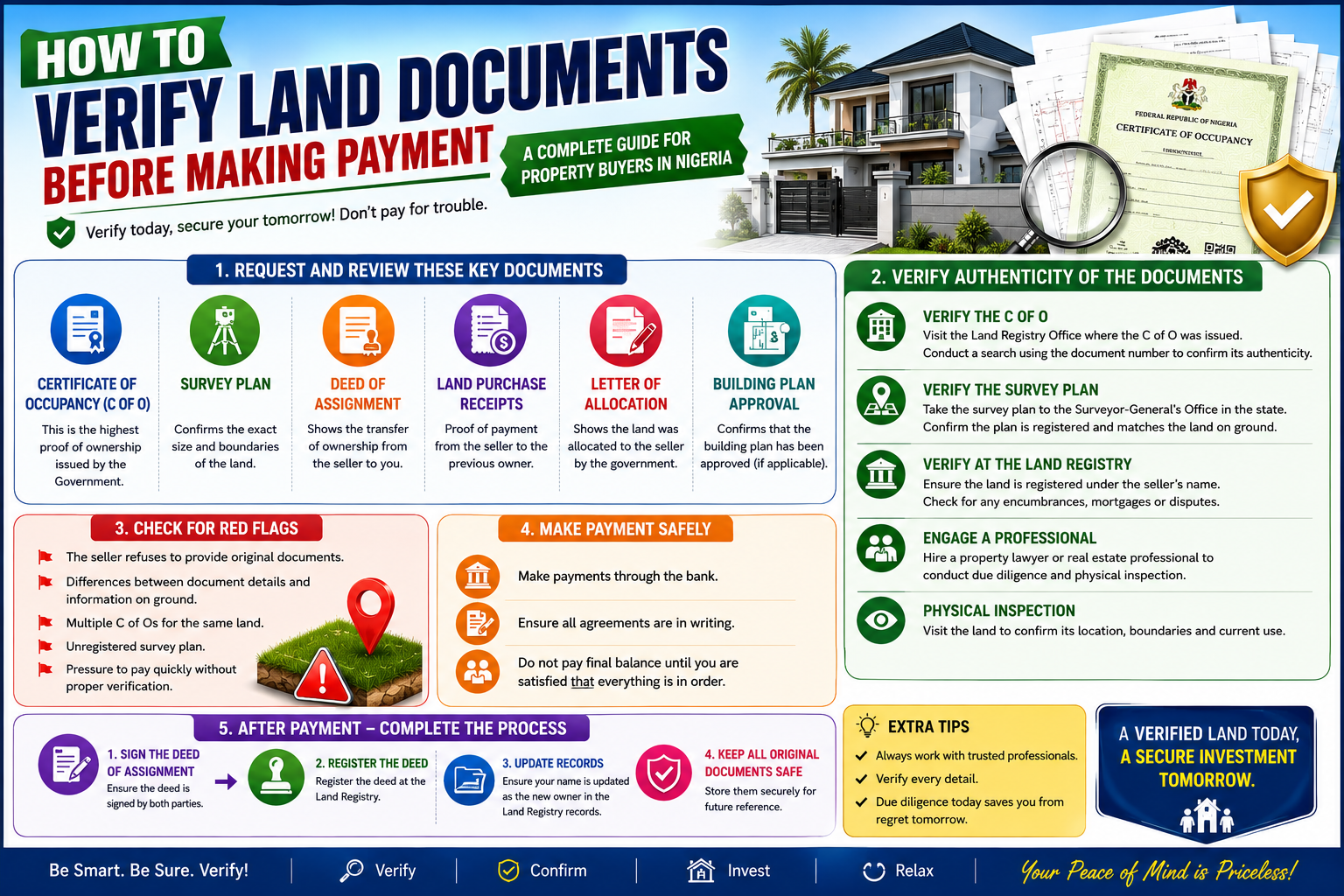
Purchasing land can be a valuable investment, whether you’re buying to build your dream home, develop commercial property, or hold the land for future appreciation. However, the potential benefits of land ownership should never overshadow the importance of proper due diligence.
Every year, buyers lose substantial sums of money because they purchase land without properly verifying the documents presented by the seller. In some cases, buyers later discover that the land belongs to someone else, is subject to government acquisition, is involved in litigation, or has been sold to multiple buyers.
Proper verification helps you confirm that the seller has a valid and transferable interest in the land, determine whether the property can legally be transferred, identify government acquisition or other restrictions, detect forged or altered documents, and uncover existing disputes or competing claims over the property.
Spending a few days on proper due diligence can save you years of legal battles and substantial financial losses. In this guide, we’ll walk you through the key steps involved in verifying land documents in Nigeria and explain what you should check before making any payment.
Step 1: Request All Available Property Documents
Ask the seller to provide copies of all documents relating to the property and their interest in it. Depending on the property’s history and the nature of the seller’s interest, these may include:
- Certificate of Occupancy (C of O)
A Certificate ofOccupancy is an official document issued by a State Government confirming the grant of a Statutory Right of Occupancy over a specific parcel of land.
Request the original copy bearing the certificate number, file number, property details, holder’s name, and other relevant particulars and take to the land registry to conduct a legal search verify its authenticity and confirm the seller’s interest.
- Right of Occupancy (R of O)
A Right of Occupancy (R of O) is a legally recognised right to occupy and use land, which may be granted by the government under the applicable land tenure system.
Where the seller relies on an R of O, request a copy of the document and verify the grant, the property details, and the seller’s interest with the land registry.
- Survey Plan
A Survey Plan identifies the location, boundaries, dimensions, and other geographical details of a parcel of land. It typically contains information such as the survey coordinates, beacon numbers, measurements and dimensions, boundary details, and the exact location of the property. The survey plan should be checked against the actual location of the property and relevant government records.
- Deed of Assignment
A Deed of Assignment is the legal instrument through which an interest in land is transferred from one party to another. Where the seller acquired the property from a previous owner, request the document through which that interest was transferred. Check the names of the parties, description of the property, title referenced in the document, date of the transaction, signature of all parties, and evidence of registration where applicable.
- Governor’s Consent
Under Nigerian law, Governor’s Consent is often required tor transfer of an existing statutory interest in land, of which failure to obtain renders the transaction inchoate. Where applicable, request evidence of the consent and verify its authenticity and connection to the property being purchased.
- Deed of Conveyance
Older properties may have a Deed of Conveyance or other historical title documents instead of a Deed of Assignment. These documents may form part of the property’s chain of title and should therefore be obtained and reviewed.
- Gazette or Excision
Where a property’s title is based on an excision, gazette, or other government documentation, request the relevant documents and verify them with the appropriate government authority.
Do not assume that the existence of an excision or gazette automatically guarantees that a particular parcel is free from acquisition or that the seller has a valid interest in it. The relevant records must be independently verified.
Remember: Receiving the Documents Is Not Verification
Obtaining copies of the documents is only the first step. A document may appear genuine but relate to a different property, contain inaccurate information, or fail to establish that the seller has a valid and transferable interest in the land.
Every document should therefore be independently verified with the relevant government authority before making any payment.
Step 2: Engage a Qualified Real Estate Lawyer
Once the seller provides copies of the available property documents, engage a qualified real estate lawyer to review them and guide you through the due diligence process.
You do not need to wait until the transaction is ready for completion before seeking legal advice. In fact, involving a lawyer at this stage allows potential problems to be identified before you make any payment or enter into a binding agreement.
A qualified property lawyer can:
- Review the documents provided by the seller and assess the seller’s interest in the property.
- Identify missing documents or information that require further investigation.
- Conduct or coordinate appropriate title and legal searches.
- Identify encumbrances, restrictions, disputes, or potential title defects.
- Advise on the legal status and risks of the proposed transaction.
- Prepare or review the agreement, Deed of Assignment, and other transaction documents.
- Confirm that the transaction complies with applicable legal requirements.
- Advise on any required consents, approvals, or registration.
- Review the results of the survey and other due diligence carried out on the property.
The cost of professional legal advice is small compared with the potential financial and legal consequences of purchasing property with defective or disputed title. Engage your lawyer before making any payment or signing a binding agreement.
Step 3: Verify the Seller’s Identity and Authority to Sell
Never assume that the person presenting the property has the legal authority to sell it.
Request a valid means of identification, such as:
- National Identity Card
- International Passport
- Driver’s Licence
- Permanent Voter’s Card
Compare the seller’s details with the names and information contained in the property documents. Where there is a difference, ask for an explanation and supporting documents before proceeding.
If the property is family-owned, confirm that the appropriate family representatives have consented to the transaction and that the person negotiating the sale has the authority to act on behalf of the family.
Where the seller is acting through an attorney, request the Power of Attorney and verify that it is valid, properly executed, and gives the attorney sufficient authority to sell or transfer the property.
For company-owned property, request relevant corporate documents, including:
- Certificate of Incorporation
- Relevant CAC records
- Board resolution or other corporate authorisation approving the sale
- Evidence of the authority of the person executing the transaction on behalf of the company
Verifying the seller’s identity and authority helps protect buyers from fraudulent transactions and unauthorised sales.
Step 4: Conduct a Physical Inspection of the Property
Never rely solely on documents, photographs, or descriptions provided by the seller. A physical inspection allows you to confirm that the property being offered is the same property described in the documents.
During the inspection:
- Confirm the location of the property.
- Compare the property’s boundaries with the survey plan.
- Check the location and condition of the survey beacons, where applicable.
- Observe surrounding developments and access roads.
- Look for signs of encroachment or occupation by third parties.
- Check for government markings, notices, or other indications that may affect the property.
- Observe the general condition and suitability of the land for its intended use.
Where there is any doubt about the property’s boundaries, location, or dimensions, engage a licensed surveyor to verify the property against the survey records.
It can also be useful to speak with neighbours, community leaders, local residents and estate associations. They may provide useful information about the property’s history, previous ownership, disputes, or other issues that may not be apparent from the documents alone. However, information obtained from residents or community members should not replace formal searches and verification with the relevant government authorities.
Step 5: Verify the Survey Plan and Government Acquisition Status
The survey plan is one of the most important documents to verify when purchasing land. A licensed surveyor should examine the survey plan and confirm that the information on it corresponds with the actual location and boundaries of the property.
The surveyor verifies:
- Whether the coordinates correspond with the stated location.
- Whether the land falls within an area affected by government acquisition.
- Whether the land falls within an excised area, where applicable.
- Whether there are overlapping or conflicting boundaries.
- Whether the property is affected by proposed roads, infrastructure projects, or other planning restrictions.
The survey verification can also help confirm that the land being offered by the seller is the same parcel described in the title documents.
Check the Government Acquisition Status
One of the most important issues to investigate is whether the property is affected by government acquisition. Land within an acquisition area may be required or reserved for public purposes, including:
- Highways and road expansion
- Schools
- Hospitals
- Housing projects
- Public infrastructure
- Drainage and other development projects
As part of the verification process, determine whether the land is:
- Free from acquisition
- Under acquisition
- Subject to committed acquisition
- Covered by an excision
- Covered by a relevant gazette
The acquisition status should be confirmed through the appropriate government authority and, where necessary, with the assistance of a licensed surveyor. Do not rely solely on the seller’s representations or informal assurances.
This stage of due diligence is particularly important because fraudulent or inaccurate survey plans can be used to misrepresent the location, boundaries, or status of a property.
Step 6: Conduct a Search at the State Land Registry
Where the property has a registrable title, conduct an independent search at the relevant State Land Registry before making payment.
A Land Registry search can help reveal information such as:
- The registered holder of the interest in the property
- Details of the registered title
- Previous registered transactions
- Existing mortgages or charges
- Caveats or restrictions
- Court orders or other registered interests
- Government interests or restrictions
- Other registered encumbrances affecting the property
Do not rely solely on photocopies or documents provided by the seller. An independent search helps confirm whether the documents presented correspond with the official records and whether there are registered interests or restrictions that could affect the transaction.
Step 7: Check for Litigation or Family Disputes and Other Claims
Some properties are subject to ownership disputes or ongoing litigation, which can significantly affect a buyer’s ability to take possession, develop, or safely acquire an interest in the property.
Ask questions such as:
- Has anyone challenged the seller’s interest in the property?
- Is the property currently subject to litigation?
- Has the property been sold or transferred previously?
- Are there disputes among family members or other persons claiming an interest in the property?
Your lawyer should conduct relevant searches and make enquiries to determine whether there are pending or previous disputes affecting the property.
Purchasing land that is subject to unresolved disputes can expose you to financial loss, competing claims, and prolonged legal proceedings.
Step 8: Verify Existing Buildings and Approvals
If the property includes a house, commercial building, or other structures, do not limit your due diligence to the land title. You should also verify that the existing developments were lawfully approved.
Request relevant documents, including:
- Approved building plans
- Development or planning permits
- Building approvals
- Completion certificates, where applicable
- Other relevant approvals issued by the appropriate authority
You should also confirm whether the property is subject to any demolition notice, enforcement action, planning violation, or other regulatory restriction.
This is particularly important when purchasing developed property because a valid title to the land does not necessarily mean that every structure on the land was lawfully constructed or approved.
Step 9: Review the Due Diligence Before Making Payment
Once the necessary searches, inspections, and verification have been completed, review the findings with your lawyer before making any payment.
If any issue has been identified, make sure it is properly explained and resolved before proceeding. Where necessary, you may renegotiate the terms, delay the transaction until the issue is resolved, or withdraw from the transaction altogether.
Do not allow pressure from the seller, attractive pricing, or fear of losing the property to override unresolved concerns.
Only proceed to payment once you are satisfied that the identified risks have been properly addressed and your lawyer has advised you to proceed. Where payment is made, ensure that there is a clear record of the transaction. Avoid making payments to third parties unless your lawyer has confirmed that the arrangement is legitimate and properly documented.
Keep copies of all payment records and documents relating to the transaction.
Step 10: Complete the Transfer and Register your Interest
After the transaction has been completed, ensure that the necessary documents, consents, and registrations are properly processed to protect your interest in the property.
Depending on the nature of the transaction and the existing title, this may include:
- Deed of Assignment or other appropriate transfer instrument
- Deed of Conveyance, where applicable
- Power of Attorney
- Governor’s Consent, where required
- Stamp duty
- Registration at the appropriate Land Registry
- Other statutory approvals or requirements applicable to the property
The specific requirements will depend on the nature of the property, the existing title, and the applicable laws. Your lawyer should advise on the appropriate documents and approvals required for your particular transaction.
Common Red Flags to Watch Out For
During your due diligence, be cautious if you encounter any of the following:
- The seller is unwilling to provide copies of relevant property documents for verification.
- The seller refuses to produce original documents for inspection when reasonably required.
- The asking price is significantly below the prevailing market value without a satisfactory explanation.
- You are pressured to make immediate payment.
- Different individuals claim ownership or authority over the same property.
- The survey plan appears altered, inconsistent, or does not correspond with the property.
- There are unresolved family or ownership disputes.
- The seller discourages you from engaging a lawyer or surveyor.
- The property’s boundaries do not correspond with the survey plan.
- Government markings, notices, or other signs of acquisition are visible on the property.
- The seller cannot adequately explain the property’s ownership history.
A red flag does not necessarily mean that a transaction is fraudulent. However, if you encounter any of these warning signs, pause the transaction and investigate the issue thoroughly before proceeding.
Final Thoughts
Buying land is not simply a financial transaction, it is a legal commitment that can have significant long-term consequences. Proper due diligence before making payment can help you identify title defects, competing claims, government acquisition, encumbrances, and other risks before they become costly problems.
From obtaining the seller’s documents and verifying their identity to conducting survey and title searches, checking for disputes, and completing the necessary registration processes, each stage plays an important role in protecting your investment.
At JEJE-OLA PROPERTIES NIG. LTD., we are committed to helping our clients make informed property decisions through transparency, proper documentation, and professional guidance. We believe that every buyer deserves confidence in the property they are purchasing.
Whether you are buying your first plot of land or expanding your investment portfolio, verify first, pay later, and invest with confidence.
Need guidance on verifying land documents or finding genuine property? Contact JEJE-OLA PROPERTIES NIG. LTD. to speak with our team about your property needs.