

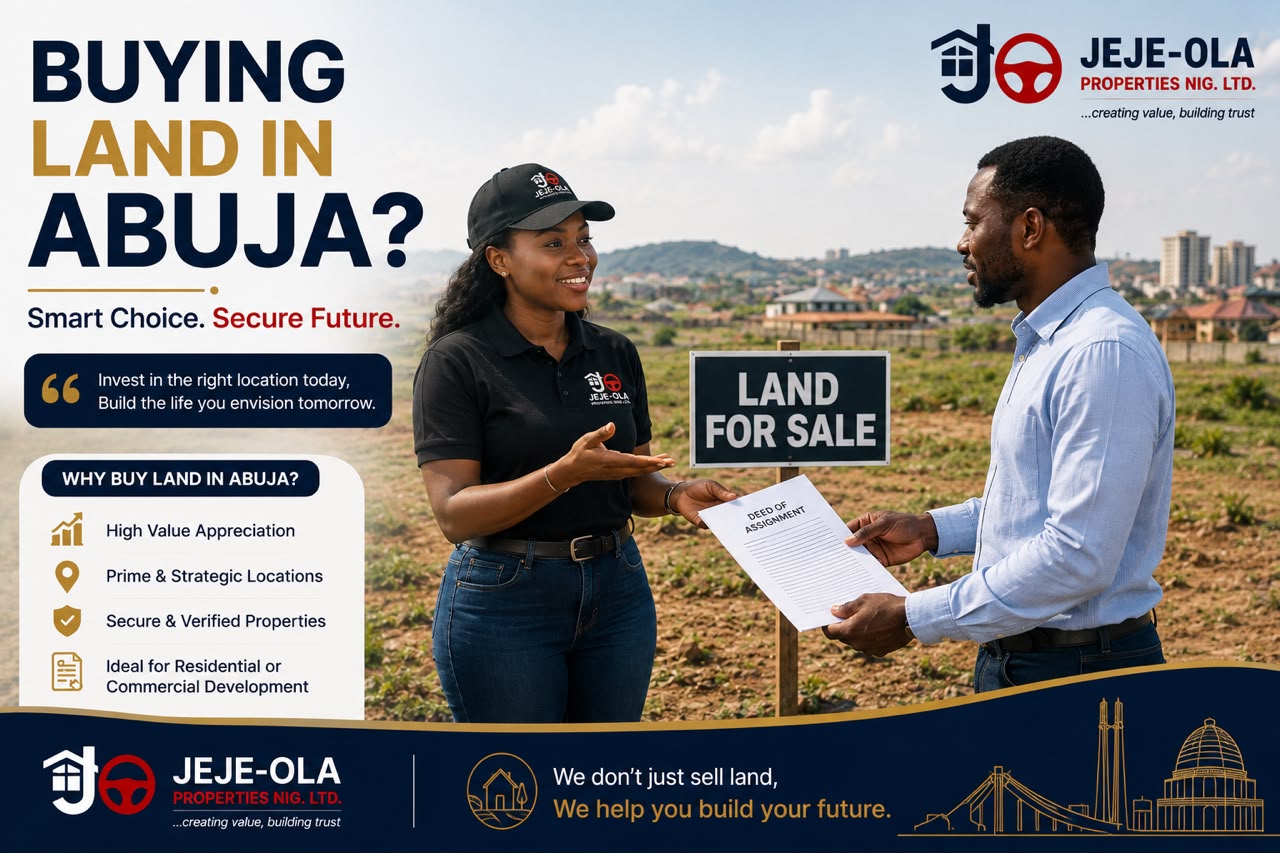
Buying land in the Federal Capital Territory (FCT) can be one of the smartest investments you’ll ever make. Whether you’re purchasing land to build your dream home, develop commercial property, or hold it as a long-term investment, Abuja’s growing population and steady infrastructure development continue to make its real estate market attractive.
However, buying land in Abuja is not without its risks. Cases of forged title documents, multiple sales of the same plot, government acquisitions, and planning violations have left many unsuspecting buyers counting heavy losses. The good news is that most of these risks can be avoided by carrying out proper due diligence before making any payment.
If you’re considering buying land in Abuja, here’s a practical checklist to help you make an informed decision and protect your investment.
1. Conduct a Physical Site Inspection
No matter how convincing the photographs, videos, or sales pitch may be, never buy land without seeing it yourself.
Visit the property and assess its physical condition. Check the terrain to determine whether it is swampy, rocky, flood-prone, or suitable for your intended development. You should also inspect the access roads, surrounding neighbourhood, and nearby developments to get a better understanding of the property’s location and potential.
A physical inspection confirms that the land actually exists, matches the description provided by the seller, and is suitable for the purpose for which you intend to use it.
2. Verify the Survey Plan, Beacons and Coordinates
A properly surveyed parcel of land should have identifiable beacon stones marking its boundaries. These beacons correspond with the property’s survey plan and help establish the exact location of the land.
Engage an independent registered surveyor to inspect the property, locate the beacon stones, verify their identification numbers, and obtain the exact GPS coordinates. This is far more reliable than relying on the seller’s representations alone.
Taking this step helps ensure that the seller is showing you the correct plot and reduces the risk of boundary disputes, overlapping allocations, or purchasing the wrong parcel of land.
3. Conduct an AGIS Search and Verify the Title
This is one of the most important stages of the entire process. The Abuja Geographic Information Systems (AGIS) is responsible for maintaining official land records within the FCT and is the primary source for verifying land ownership and title.
Submit the survey details, GPS coordinates, and all available title documents—such as the Certificate of Occupancy (C of O), Right of Occupancy (R of O), Allocation Letter, and any Deeds of Assignment—for an official search. If the property has changed hands over the years, ensure there is a complete chain of documents showing how ownership passed from one owner to another.
An AGIS search helps confirm that the seller is the lawful owner, that the title documents are authentic, and that the land is not under government acquisition or subject to any encumbrance, such as a mortgage. It also helps identify gaps in the property’s ownership history that may indicate ownership disputes, defective title, or fraud. Completing this step before paying for the land can save you from costly legal and financial problems.
4. Verify the Zoning and Planning Status
Abuja is a carefully planned city, and every district and plot is designated for a specific purpose under the Abuja Master Plan. A piece of land may be approved for residential, commercial, industrial, institutional, agricultural, or mixed-use development, and using it for a different purpose could have serious consequences.
Before purchasing the property, confirm with the FCTA Department of Development Control that the land is approved for your intended use and complies with the Abuja Master Plan.
This step is important because zoning regulations are legally enforceable. If you develop or use land in a manner that is inconsistent with its approved zoning or the conditions attached to its title, the FCTA may take enforcement action. Depending on the circumstances, this could include stop-work orders, demolition of unauthorized structures, or even revocation of the right of occupancy. Verifying the planning status beforehand helps ensure your proposed development is lawful and protects your investment.
5. Find Out About Additional Costs and Fees
The purchase price is often only one part of the total cost of buying land. Many buyers focus on the selling price without asking about other charges that may become payable before they can take possession or begin development.
If the property is located within a private estate or community, ask for a detailed breakdown of all applicable fees. These may include infrastructure or development levies, survey and documentation fees, legal fees, estate service charges, or community clearance fees where applicable.
Understanding these costs from the outset allows you to budget properly and avoids unpleasant surprises later. In some cases, these additional charges can significantly increase the overall cost of acquiring the property.
6. Engage an Independent Property Lawyer
While estate agents and sellers play important roles in the transaction, they do not represent your legal interests. One of the best investments you can make during the purchase process is engaging your own independent property lawyer.
Your lawyer should review the title documents, conduct legal due diligence, prepare or review the Contract of Sale and Deed of Assignment, advise you on any legal risks, and oversee the completion of the transaction.
Having independent legal representation helps ensure that your interests are protected, the documentation is in order, and the transaction is completed in accordance with the law.
Final Thoughts
Buying land in Abuja is a significant financial decision, and it is not one that should be rushed. If a seller or agent pressures you to make an immediate payment because “another buyer is interested,” take it as a cue to slow down rather than speed up.
Taking the time to inspect the property, verify the title, confirm the planning status, and seek professional advice can save you years of legal disputes and substantial financial loss. A little due diligence today can make all the difference tomorrow.
Looking to buy verified, legally secure land in Abuja? Our team can guide you through every stage of the acquisition process—from due diligence and title verification to documentation and completion—so you can invest with confidence. Contact us today to explore our carefully vetted property listings.